Table of Contents
- Why Performance Tuning Matters for Vintage Cars
- Summerlin-Specific Performance Challenges
- Types of Performance Tuning
- The Dyno Tuning Process
- Supporting Systems: Intake, Exhaust & Cooling
- Choosing the Right Tune for Your Classic
- 777 Motorsports Performance Tuning Workflow
- Complementary Upgrades
- Service Areas We Cover
- Maintenance & Follow-Up
- Frequently Asked Questions
- Ready to Unlock Your Vintage’s Potential?
Why Performance Tuning Matters for Vintage Cars
Vintage engines were designed in an era of looser emissions and lower RPM limits. Over decades, components wear, tolerances shift, and generic jetting or timing tables lose their edge. Proper performance tuning:
- Restores Lost Power by correcting air/fuel and spark curves that have drifted from factory settings.
- Improves Throttle Response eliminating flat spots and hesitation, especially important in stop-and-go traffic on Summerlin Parkway.
- Enhances Fuel Economy by optimizing cruise-overdrive shift points and lean-burn maps.
- Prolongs Engine Life through correct mixture and timing, reducing detonation and wear.
Without tuning, even a rebuilt engine won’t deliver its true capabilities—wasting both your money and driving enjoyment.
Summerlin-Specific Performance Challenges
Summerlin’s environment places unique demands on vintage engines:
- High Elevation (~2,000 ft) reduces air density by ~6 % vs. sea level, requiring compensation in fuel and ignition for consistent power.
- Desert Heat (100–115 °F) leads to intake-air temperatures over 160 °F, promoting detonation and power loss.
- Fine Dust & Sand clog carburetor bowls and intake runners, skewing jetting and sensor readings.
- Steep Canyon Roads of Red Rock Canyon demand strong mid-range torque and reliable cooling under sustained loads.
A tune that works at sea level or in milder climates will run lean, knock, or simply lack punch in Summerlin—highlighting the need for local expertise.
Types of Performance Tuning
Carburetor Jetting & Fuel Mixtures
For carb-equipped classics, correct jet sizing and float levels are paramount:
- Primary & Secondary Jet Selection
- Match the venturi airflow to the engine’s displacement, cam profile, and intake.
- Float Height Adjustment
- Prevent fuel starvation under acceleration and cornering.
- Air Bleed Tuning
- Fine-tune mixture at idle and cruising speeds.
- Altitude Compensation
- Lean out by ~6–8 % at 2,000 ft; adjust main jets or install altitude-compensating kits.
Properly jetted carbs eliminate bogging, backfiring, and uneven idle.
Ignition Timing & Distributor Calibration
Mechanical distributors require dynamic timing curves:
- Initial Timing set for optimal idle vacuum (14–16° BTDC).
- Mechanical Advance Weights calibrated for torque-curve shape—quick advance for low RPM torque, gradual for high end.
- Vacuum Advance tuned for part-throttle efficiency; aftermarket canister rates adjusted for cruise lean-burn.
- High-Performance Distributors with adjustable ramps and heavy weights help control detonation under Summerlin’s heat.
Upgrading to an electronic ignition module (e.g., MSD) paired with a dyno-tuned spark table yields the crispest combustion.
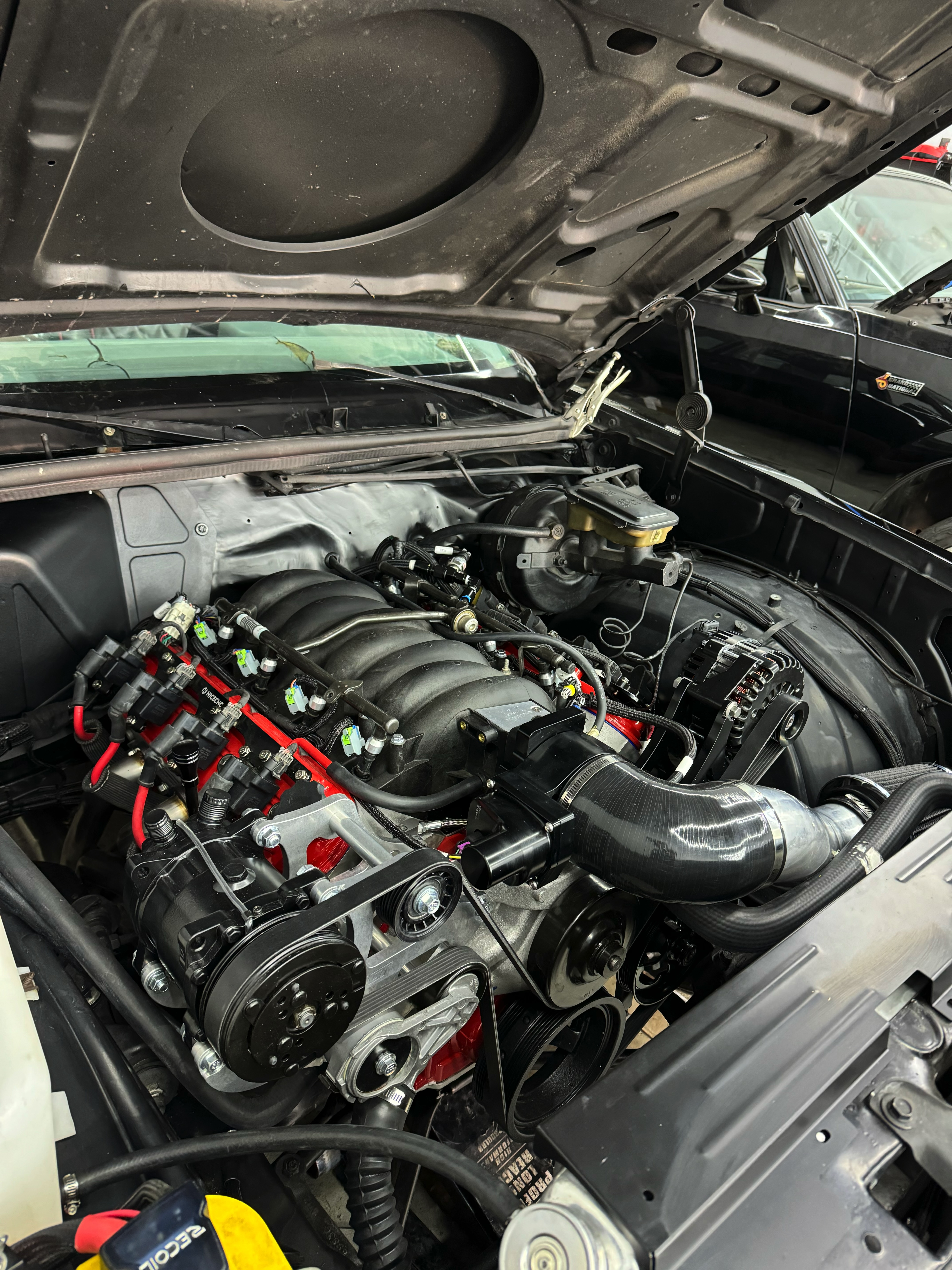
ECU Remapping & Chip Tuning
For EFI restomods or late-’80s/’90s classics, ECU flash tuning unlocks sophisticated control:
- Fuel Map Optimization across RPM/load bins, with altitude and temperature compensation.
- Ignition Map Refinement to maximize safe spark advance using knock sensors.
- Throttle-Body Calibration smoothing electronic throttle for civilized low-speed response.
- Torque Management & Shift Strategy ideal for overdrive automatics on Summerlin freeways.
Our handheld ECU flashing devices and stand-alone ECU calibrations ensure each table is tailored to your exact engine, gearing, and local conditions.
Forced-Induction Management
Supercharged or turbocharged vintage engines need precise boost control:
- Boost Target Maps limiting manifold pressure to safe levels at all altitudes.
- Wastegate & Bypass Calibration for smooth transitions and anti-surge protection.
- Intercooler Efficiency Checks ensuring intake temps stay below 120 °F to avoid detonation.
- Fueling Upgrades including high-flow injectors and pressure regulators, mapped on the dyno.
A proper forced-induction tune transforms raw power into reliable, street-friendly performance.
The Dyno Tuning Process
Our Dynojet chassis dyno in Las Vegas allows real-world simulation under controlled conditions:
- Baseline Run capturing stock or previous tune output.
- Incremental Adjustments to fuel and spark, logging AFR (air/fuel ratio) and knock sensor data.
- Load-Simulated Pulls at temperatures up to 115 °F to mimic Summerlin drives.
- Final Validation confirming target horsepower, torque curves, and consistent AFR across the map.
- Data Logging handed over to you via USB for future reference or seasonal retunes.
Dyno tuning delivers repeatable, quantifiable gains and is indispensable for high-performance setups.
Supporting Systems: Intake, Exhaust & Cooling
A tune is only as good as the systems it governs:
- Intake: Clean, heat-shielded air filters; sealed cold-air boxes to reduce 160 °F inlet temps.
- Exhaust: Free-flow headers and 2.5″–3″ exhaust pipes to minimize backpressure and improve scavenging.
- Cooling: Oversized aluminum radiators, dual SPAL fans, and optionally an oil cooler to maintain 200 °F levels on canyon runs.
- Fuel Delivery: 255–340 lph pumps and correctly sized lines to prevent starvation under hard acceleration.
We integrate these upgrades in tandem with your tune, guaranteeing the engine can breathe, breathe out, and stay cool.
Choosing the Right Tune for Your Classic
Consider your driving style and goals:
- Weekend Cruiser: Mild cam, mild tune, emphasis on mpg and smooth low-end torque.
- Canyon Carving: Aggressive mid-range punch, strong throttle response, and precise spark control.
- Show & Shine: Drivability with occasional bursts—safe conservative maps with occasional “Performance” mode.
- Track-Day Vintage: High-RPM stability, high-stall converter or manual-clutch engagement maps.
Our free vision sessions help you pick the ideal balance of power, economy, and reliability.
777 Motorsports Performance Tuning Workflow
- Initial Consultation
– Review your car’s history, modifications, and Summerlin-specific challenges.
- Vehicle Inspection
– Check ignition, fuel, intake, exhaust, and cooling systems to ensure they’re tune-ready.
- Baseline Testing
– Perform datalogging drives on local roads (Summerlin Parkway, Red Rock Canyon loops) and on-chassis dyno.
- Tuning Sessions
– Iterative fuel/spark map adjustments, carb jet changes, or ECU reflashes.
- Validation & Road-Test
– Confirm performance gains under real conditions, followed by a customer demo.
- Documentation & Training
– Provide tune files, AFR logs, and teach you how to monitor knock and AFR gauges.
Every tune concludes with a 1-year/12k-mile warranty on calibrations and lifetime support for retunes.
Complementary Upgrades
To maximize and maintain your tune’s gains, consider:
Bundling services saves labor and avoids repeated tear-down / re-assembly.
Service Areas We Cover
Based in Las Vegas at 3271 S Highland Dr #709, we proudly serve vintage-car owners across:
- Summerlin North & South (The Ridges, The Trails, Sun City Summerlin)
- Henderson (Green Valley, Anthem, Inspirada)
- North Las Vegas (Aliante, Eldorado)
- Paradise & Spring Valley (The Strip, Arts District)
- Boulder City & Lake Mead
- Pahrump & Sloan (mobile tuning services available within 45 miles)
Enclosed transport protects your classic during dyno and tuning services.
Maintenance & Follow-Up
To preserve your tune:
- Quarterly AFR Checks – Verify air/fuel ratios haven’t drifted.
- Annual Tune-Up – Re-inspect timing, carb sync, and sensors.
- Pre-Season Retune – Adjust for cooler winter air vs. 115 °F summer peaks.
- Knock Sensor Monitoring – Install a knock control unit or wideband AFR gauge for real-time alerts.
Our Driver’s Club membership offers discounted retunes, priority scheduling, and free seasonal tune adjustments.
Frequently Asked Questions
- How much power can I expect from a tune alone?
→ Typically 5–15% engine output gains, depending on existing mods and condition.
- Do I need a dyno to get tuned?
→ For EFI and forced-induction cars, yes. Carb and ignition tuning can start on-road, but dyno yields precise results.
- Is ECU remapping reversible?
→ Absolutely—original maps are saved before any flash, allowing full rollback at any time.
- Can you tune my original Ford Holley carb?
→ Yes—we jet and calibrate Holleys, Edelbrocks, and other vintage carbs for local altitude and heat.
- What’s the turnaround time?
→ Most tuning jobs complete in 1–2 days; forced-induction and EFI calibrations may take 2–3 days.
- How do I know if my car is a good candidate?
→ If it hasn’t been tuned in the last 3 years or you’ve added performance parts, a tune will unlock noticeable benefits.
- How do I schedule a session?
→ **Call (844) 777-
::contentReference[oaicite:0]{index=0}